
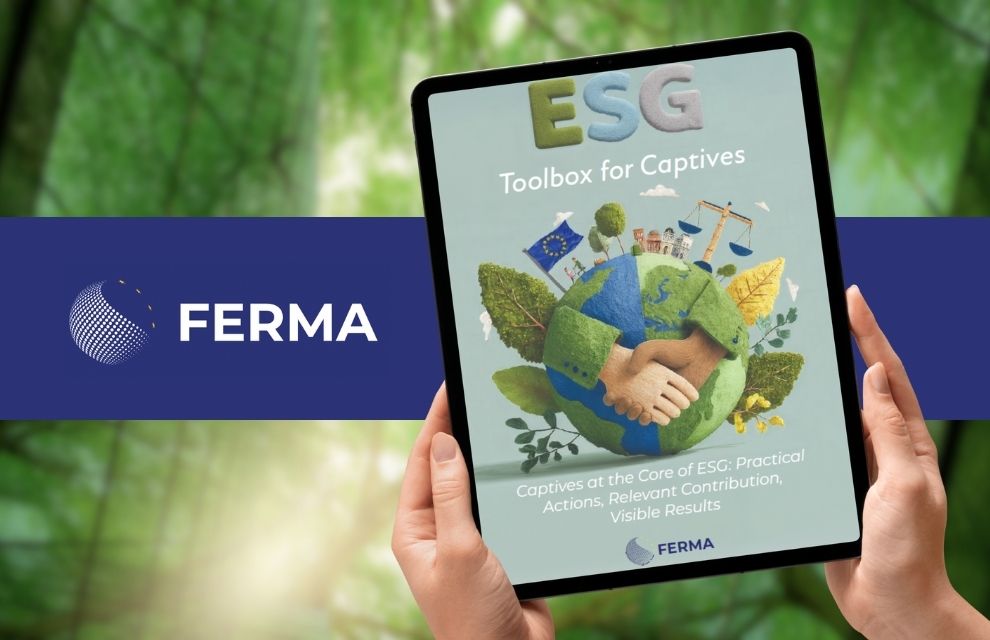
Captives play a key role in facilitating their parent organisation’s environmental, social and governance (ESG) objectives, according to a new report from the Federation of European Risk Management Associations (FERMA). The report, ESG – Toolbox for Captives, provides practical advice on how the risk transfer mechanism can be used to embed ESG commitments throughout everyday insurance and risk management activities. While acknowledging that a captive’s primary function is not to drive the ESG strategy of its organisation, the report positions captives as "catalysts capable of embedding, supporting or incentivising positive changes" across the entire group. The Toolbox, developed by FERMA’s Captive Committee, is intended as a source of ideas to stimulate dialogue and inspire action, rather than a "rulebook". It highlights five key areas of impact: underwriting, claims management, investments and funding, risk data collection, and insurance innovation. Embedding Environmental Goals For the Environmental pillar, the report recommends that captive owners embed industry-relevant environmental Key Performance Indicators (KPIs) into the underwriting process. This approach enables differentiated premium allocation, which rewards entities with stronger environmental performance. The toolkit details how captives can directly support the transition to a low-carbon economy in several ways: • Investment and Funding: Captives can allocate surplus capital to finance the parent group's environmental initiatives, such as green bonds or renewable energy projects. • Claims Management: Captives can cover 'betterments' in claims to implement an environmentally conscious 'build back better' philosophy. This allows for upgrades to sustainable features, such as energy-efficient insulation or LED lighting systems, following a loss. • Transition Risk Innovation: Captives are encouraged to fill insurance gaps for unproven or evolving technologies, such as hydrogen or carbon capture, where the traditional market is hesitant to provide coverage. Social and Governance Impact On the Social front, the report suggests captives expand employee benefits programmes to offer customised coverage, including mental health and resilience initiatives. They can also use social KPIs in underwriting, such as the Lost-Time Injury Frequency Rate (LTIFR) or the Gender Diversity Ratio, to incentivise best practices across business units. The use of analytics from employee benefits data can also drive targeted, preventative wellness programmes. The Governance pillar focuses on the captive itself, with FERMA stressing the importance of a strong governance system. This includes selecting a reputable domicile and promoting board diversity and independence. Furthermore, the captive can use its claims and exposure data to provide insights back to the business, promoting a stronger risk culture across the parent organisation by rewarding stronger risk controls through its premium allocation models. Laurent Nihoul, Chairman of the Captive Committee, says the toolbox is designed to promote dialogue and encourage creative thinking. “The ESG toolbox emphasises flexibility over rigid standards, aiming to promote greater dialogue and encourage creative thinking around captives and ESG strategies, while helping captive owners design and implement their own solutions. By reimagining routine (re)insurance and risk management activities as opportunities for making an impact on ESG initiatives, captives can turn risk financing into a strong driver of sustainability,” he adds. Philippe Cotelle, President of FERMA, notes that the report explores how captives play a strategic role in supporting ESG transformation. “FERMA is committed to sharing knowledge and promoting innovation and through this report we want to explore how captives can play a strategic role in supporting ESG transformation. By embedding ESG into insurance and risk financing activities, captives can translate sustainability goals into practical action, strengthen their parent organisations’ ESG commitments, while driving long-term value and fostering responsible growth,” he says.
